
For years, I believed the same myth a lot of curly-haired women believe: short hair and curly hair don’t mix well, because short curls just shrink up into something small and flat against the head. I held onto my long curls partly out of habit and partly out of genuine fear that cutting them short would mean losing all the volume and presence my hair had.
Then a close friend of mine, who has curls tighter than mine, chopped hers into a pixie last year, and it was honestly one of the most dramatic, gorgeous hair transformations I’ve witnessed in person. Her hair didn’t shrink into something small. It exploded into this voluminous, sculptural shape that looked more striking than her long hair ever did.
That was the moment I realized the myth was wrong. Curly pixie cuts, done correctly, are not about minimizing your hair. They’re about maximizing it in a completely different direction. I eventually took the leap myself, and I want to walk you through everything I’ve learned — from my friend’s experience and my own — about why curly pixie cuts can be some of the most volume-packed, head-turning styles out there.
Why People Assume Curly Pixies Lack Volume (And Why That’s Wrong)
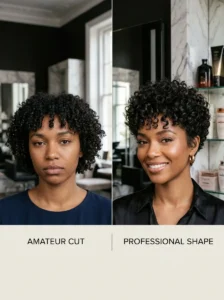
The misconception usually comes from one of two places: either someone has seen a poorly cut curly pixie that genuinely did look flat and shapeless, or they’re picturing pixie cuts designed for straight hair, which rely on a completely different technique.
A pixie cut for straight hair is typically cut close to the head with minimal layering needed to create shape, since straight hair naturally lies flat and the style depends on precise lines. Apply that same technique to curly hair without adjustment, and yes, you’ll get a flat, shrunken result that doesn’t show off the curl pattern at all.
But curly hair behaves completely differently. It needs to be cut with an understanding of how each curl will spring up and outward once it’s dry. When that’s done correctly, the natural volume of curly hair becomes the star of the cut rather than something to manage or minimize.
1. The Curly Crop with Height
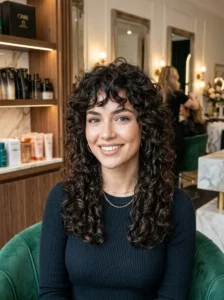
A short pixie with extra length and volume left specifically at the crown, allowing curls to spring upward dramatically. This is the style my friend got, and it remains one of the most striking versions of the curly pixie because the height creates an almost architectural silhouette.
Best for: Medium to tight curl patterns, oval and heart-shaped faces.
2. The Tapered Curly Pixie
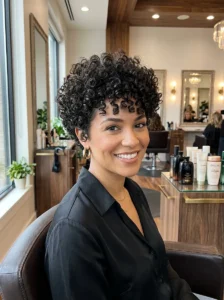
Short, tapered sides and back paired with longer curls left on top. This is one of the most popular curly pixie variations because the contrast between the close-cropped sides and the voluminous top creates dramatic shape without overwhelming the whole head.
This is the version I eventually got, and the tapering made the volume on top look even more pronounced by comparison.
Best for: All curl patterns, especially tighter curls and coils.
3. The Curly Pixie with Undercut
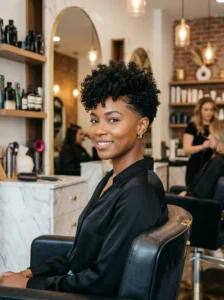
A shaved or very closely cropped undercut beneath longer curls on top, often visible when the top hair is styled up or to the side. This is a bold, editorial option that works particularly well for those who want maximum contrast and don’t mind a more dramatic statement.
Best for: Medium to tight curls, all face shapes.
4. The Voluminous Curly Afro Pixie
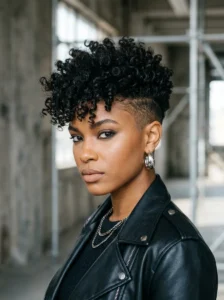
A short, evenly shaped pixie that allows tight curls and coils to form a rounded, voluminous silhouette reminiscent of a mini afro. This style celebrates natural texture at its fullest and tends to provide the most dramatic volume of any pixie variation.
Best for: Tight curls and coils, round and oval face shapes.
5. The Side-Swept Curly Pixie
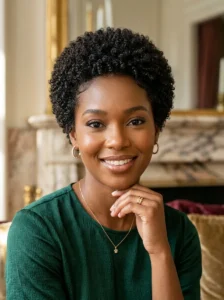
Slightly longer curls on top styled to sweep to one side rather than standing straight up, creating an asymmetrical, softer silhouette. This version tends to read as slightly more polished and works well for professional settings.
Best for: Loose to medium curls, square and round face shapes.
6. The Curly Pixie Mullet
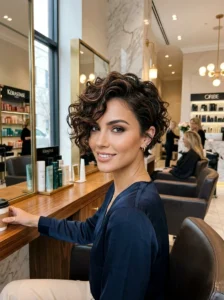
A short pixie shape on top and sides combined with a slightly longer section left at the nape of the neck. This unexpected combination has become increasingly popular for curly hair because the longer back section adds dimension and prevents the cut from feeling too uniform.
Best for: Medium to tight curls, those wanting a bold, modern statement.
7. The Defined Curl Pixie
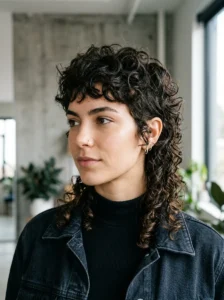
A pixie cut styled with heavy emphasis on individual curl definition rather than overall volume — each curl is encouraged to clump and form its own distinct shape using the praying hands technique with curl cream. The result is less about overall poof and more about sculptural, defined ringlets.
Best for: Medium curl patterns with strong natural curl definition.
8. The Curly Pixie Bob Hybrid
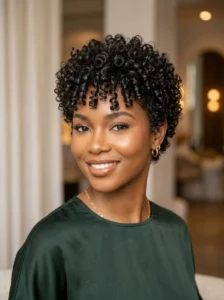
A slightly longer pixie that blends into bob territory at the back and sides, creating more length and versatility while maintaining short, voluminous curls at the crown. This is a great option for those nervous about going too short who still want the volume benefits of a pixie cut.
Best for: Loose to medium curls, those transitioning from longer hair.
9. The Curly Pixie with Fringe
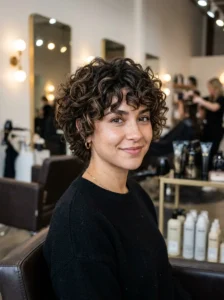
Short curls on top and sides paired with a slightly longer, curly fringe that falls forward over the forehead. This adds a soft, face-framing element to the typically more structural pixie silhouette.
Best for: All curl patterns, oval and long face shapes.
10. The Sculptural Curly Pixie
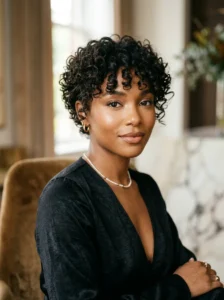
An intentionally asymmetrical, artistically shaped pixie where curls are cut at varying lengths to create a sculptural, almost abstract silhouette. This is the most editorial and bold option on this list, best suited for those who want their hair to function as a genuine style statement.
Best for: Medium to tight curls, those comfortable with a dramatic, fashion-forward look.
The Cutting Technique That Actually Matter
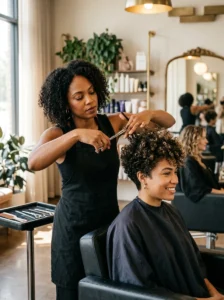
After watching my friend’s stylist work and going through the process myself, here’s what I learned makes the real difference between a curly pixie that has volume and one that falls flat.
Dry cutting is essential. Just like with longer curly cuts, a properly executed curly pixie needs to be cut while the hair is dry, so the stylist can see exactly how each section will shrink and sit once finished. Cutting curly hair wet for a pixie almost always results in a much shorter, flatter outcome than intended once it dries.
Curl-by-curl shaping. Rather than cutting in uniform sections the way you might for straight hair, a skilled curly pixie specialist works curl by curl, assessing how each section’s natural spring and direction will contribute to the overall shape.
Strategic length variation. The volume in a great curly pixie often comes from subtle differences in length between the crown, sides, and nape, allowing curls of different lengths to create dimension and height rather than one uniform, flat shape.
Avoiding over-thinning. It can be tempting to thin out curly hair to manage bulk, but over-thinning a pixie often removes the very curls that create volume and shape. A good stylist removes weight strategically rather than uniformly.
Finding the Right Stylist
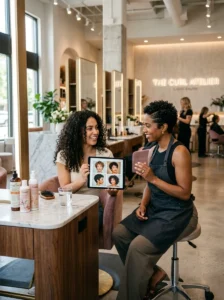
This might be the single most important factor in whether your curly pixie has volume or falls flat. Here’s how to find someone qualified:
Look for curly hair specialists specifically. Many salons now have stylists who specialize in curly and textured hair. A general stylist who primarily works with straight hair may not have the specific technique knowledge needed for a great curly pixie.
Check their portfolio for short curly cuts specifically. A stylist might be wonderful with long curly hair but have limited experience with the more precise, structural cutting that a great curly pixie requires.
Ask about their dry-cutting process. If a stylist seems surprised or hesitant when you ask about cutting your hair dry, that may be a sign they’re less experienced with curly-specific techniques.
Read reviews mentioning pixie cuts on curly or coily hair specifically. General positive reviews don’t necessarily mean a stylist excels at this particular combination.
How to Style a Curly Pixie for Maximum Volume
Getting the right cut is the foundation, but styling technique matters enormously for a curly pixie. Here’s the routine that’s worked best for me and that my friend swears by as well.
Apply product to soaking wet hair. Just like longer curly styles, a curly pixie benefits from curl cream or gel applied while hair is still dripping wet, allowing even distribution before the curl pattern sets.
Scrunch upward, focusing at the roots. Since the crown area is often where the most dramatic volume comes from, focus your scrunching technique there, encouraging curls to spring upward rather than just defining the ends.
Diffuse upside down for extra lift. Flipping your head over and diffusing from underneath adds significant volume at the roots, which matters even more on a short cut where every bit of lift is visible.
Avoid heavy products. Heavy creams, oils, or pomades can weigh down short curls quickly, flattening the very volume you’re trying to achieve. Lightweight, curl-specific products work much better for pixie lengths.
Use your fingers, not a brush, to refresh. On second or third day hair, lightly finger-styling with a small amount of water or refreshing spray maintains volume far better than brushing, which disrupts curl clumps and creates frizz.
What I Wish I’d Known Before Cutting My Curls Short
Looking back at my own experience, here’s what would have been helpful to know going in:
It looks shorter immediately after the cut than it will in a few days. Freshly cut curls often appear more compressed right after the appointment. As the cut settles and you find your styling routine, the volume becomes more apparent.
You’ll need to relearn your styling routine somewhat. What worked for long curls doesn’t translate exactly to short curls. Give yourself a few weeks to adjust your product amounts and techniques.
Trims matter even more. With a longer style, growing out unevenly is less noticeable. With a pixie, even small amounts of uneven growth show clearly. Plan for trims every four to six weeks to maintain the shape.
The compliments are real and frequent. Both my friend and I were genuinely surprised by how many compliments we received after going short. There’s something about a well-executed curly pixie that draws attention in a way long hair often doesn’t.
Final Thoughts
If you’ve been holding onto length out of fear that short curly hair means losing volume, I want to gently push back on that assumption, because my own experience completely disproved it for me. The right curly pixie cut, executed by someone who understands curl texture, can create more dramatic, voluminous shape than length ever did.
It’s a bigger commitment than a trim, and it does require finding the right stylist and adjusting your styling routine. But if you’re curious about going short, I’d genuinely encourage you to look into it rather than assuming your curls won’t have the volume you’re hoping for.
Sometimes less length really does mean more impact.