
I’ve spent more money than I’d like to admit on volumizing products over the years, chasing the kind of fullness I see on people with naturally thick hair. Mousses, root sprays, thickening shampoos, dry shampoo applied at unreasonable frequencies. Some of it helped marginally. None of it solved the underlying problem, which was that my actual haircut was working against me, not with me.
It wasn’t until a stylist who specializes in fine hair sat me down and explained that volume starts with the cut, not the products, that things actually changed. She walked me through exactly why certain cuts create the illusion of thickness and others make thin hair look even thinner, regardless of how much product gets piled on afterward. I want to share everything I learned, both from her and from my own months of testing different approaches since then.
Why Cut Matters More Than Product for Thin Hair
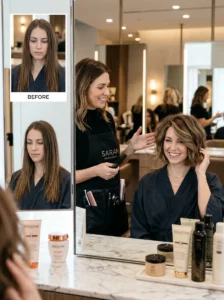
This was the single biggest mindset shift in my own hair journey, so it’s worth explaining clearly before getting into specific styles.
Volumizing products work by lifting hair at the roots or adding texture to the hair shaft, but they can’t fundamentally change the silhouette created by your haircut. If your cut is one uniform length with no strategic layering, no amount of root spray will create the illusion of fullness that a well-planned cut achieves naturally. The shape of the cut itself either works with thin hair’s tendency to lie flat, or it fights against it.
Conversely, a haircut specifically designed around thin hair’s characteristics can create the appearance of significantly more volume even before you pick up a single product, simply through strategic length, layering placement, and overall shape.
1. The Blunt Bob

A single-length, blunt-cut bob is one of the most reliably volumizing cuts for thin hair, and it was genuinely surprising to learn why. When all the ends line up at the same length, they create a solid, weighted line that reads as denser and fuller than the same amount of hair cut with soft, graduated layers that taper the ends thinner.
This was the first cut I tried based on my stylist’s recommendation, and the difference was noticeable from the moment she finished blow-drying it.
Best for: Fine to very fine hair, most face shapes.
2. The Textured Pixie
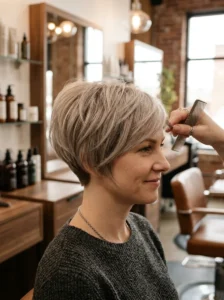
Short hair generally appears fuller simply because there’s less length and weight pulling it down toward the scalp. A textured pixie, with strategic shorter layers at the crown, takes this even further by encouraging natural lift and movement.
Best for: Very fine hair wanting maximum apparent volume, oval and heart-shaped faces.
3. The Lob With Root-Focused Layering

A longer bob with layering concentrated specifically near the roots and crown, rather than throughout the entire length, encourages volume exactly where thin hair tends to lack it most while still allowing for more length than a classic short bob.
Best for: Fine to medium-fine hair wanting more length than a bob.
4. The Curly or Wavy Bob

For those with naturally wavy or curly fine hair, a bob length specifically allows the natural texture to create volume that longer lengths often can’t sustain, since the weight of longer hair frequently stretches out and weakens natural curl or wave pattern.
Best for: Fine, wavy or curly hair.
5. The Shag With Heavy Crown Layering

A shag haircut with particularly heavy layering concentrated at the crown creates dramatic lift and volume at the root, while the longer, lighter layers throughout the rest of the cut prevent the overall style from looking too short or severe.
I tried this version about six months after my initial blunt bob, wanting a bit more length, and the crown volume remained just as noticeable as my shorter cut had achieved.
Best for: Fine to medium hair wanting more length with maintained volume.
6. The Blunt Lob

Similar logic to the blunt bob but at a slightly longer length, this cut maintains the same weighted, dense-looking edge while offering a bit more versatility for those not ready to commit to chin-length hair.
Best for: Fine to medium-fine hair wanting a longer length while maintaining apparent density.
7. The Pixie Bob Hybrid
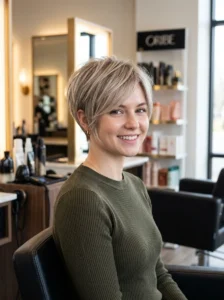
A length between a true pixie and a classic bob, with shorter, textured pieces at the crown blending into a slightly longer perimeter. This combination captures much of the volume benefit of a true pixie while offering a bit more length and styling versatility.
Best for: Fine hair wanting volume without committing to an extremely short pixie.
8. The Curtain Bang Bob

Adding curtain bangs to a blunt or lightly layered bob creates additional visual fullness specifically around the face, which is often the area where thin hair’s limitations are most noticeable in everyday interactions and photos.
Best for: Fine to medium hair, most face shapes.
9. The French Bob

A shorter, chin-length or above-chin bob with a softer, slightly rounded shape rather than a severely blunt line. This style has become popular partly because its shorter length naturally suits fine hair’s tendency to look fuller with less overall weight.
Best for: Very fine hair, oval and round face shapes.
10. The Tapered Crop
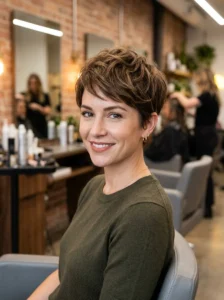
An extremely short, closely tapered cut that essentially eliminates the weight problem entirely by keeping length minimal throughout, allowing fine hair’s natural texture and any styling product to have maximum visible impact.
Best for: Very fine hair, those willing to commit to a bold, short style.
The Cutting Techniques That Actually Create Volume
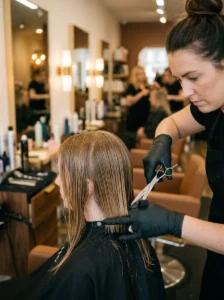
Beyond just the overall shape, a few specific techniques matter enormously in how a stylist executes any of these cuts for genuinely fine hair.
Avoiding over-thinning. This might be the single most counterintuitive lesson I learned. It’s tempting to think thinning shears would help fine hair somehow, but thinning removes density that fine hair can’t afford to lose. A skilled stylist working with fine hair typically avoids thinning shears almost entirely.
Strategic, not uniform, layering. Layering throughout the entire length of fine hair, the way you might for thick hair needing weight removed, often makes thin hair look even sparser. Layering concentrated specifically at the crown or root area, while keeping the perimeter blunt and weighted, creates volume without sacrificing the appearance of density.
Considering the natural fall of the hair. A good stylist for fine hair pays close attention to exactly how the hair naturally falls and where it tends to look flattest, planning the cut’s layering and length specifically around those problem areas rather than applying a generic technique.
Styling Techniques to Maximize Your New Cut

Getting the right cut is the foundation, but the right styling approach makes a significant additional difference. Here’s what’s worked consistently for me since switching to a fine-hair-specific cut.
Apply volumizing product to roots on damp hair before blow-drying. This step matters more than almost any other in my routine. A small amount worked specifically into the roots, avoiding the lengths, creates significantly more lift than applying product evenly throughout.
Blow-dry upside down initially. Flipping your head over for the first few minutes of blow-drying encourages the roots to dry with lift, which is much harder to achieve if you blow-dry with your head upright the entire time.
Use a round brush at the roots specifically, even if air-drying the rest. Even a quick pass with a round brush focused just at the roots, while letting the rest of your hair air dry or finish more casually, can add noticeable volume without requiring a full, time-consuming blowout.
Consider dry shampoo as a volumizing tool, not just an oil-absorber. Applying a small amount of dry shampoo to the roots even on freshly washed hair adds texture and grip that helps volume hold throughout the day, beyond just its traditional oil-absorbing function.
Avoid heavy, oil-based products entirely. These products are popular for thick or curly hair types but can be genuinely counterproductive for fine hair, weighing it down and undoing any volume your cut and other styling efforts created.
How Often to Trim for Maintained Volume
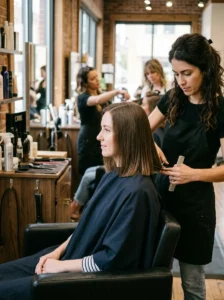
Fine hair cuts, especially those relying on precise blunt lines or strategic crown layering, tend to need slightly more frequent trims than some other hair types, since even small amounts of growth can shift the careful balance that creates the volume illusion.
I get a trim every six weeks now, which keeps my blunt line crisp and my crown layering at the right length to maintain lift. Letting it grow even slightly longer between appointments noticeably reduces how full my hair looks by the end of that stretch.
What I Wish I’d Known Years Ago
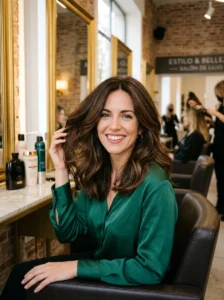
Looking back at all those years and all that money spent on volumizing products before finally addressing the actual cut, here’s what I wish someone had told me much earlier.
No product can fully overcome a cut that’s working against your hair’s natural characteristics. I spent years treating the symptom rather than the actual cause.
A stylist who specializes in fine hair specifically is worth seeking out, even if it means switching from a stylist you’ve used for years. The technique knowledge genuinely makes a measurable difference.
Shorter, in general, tends to be a fine hair’s friend, even when it feels like a bigger commitment than you’re initially comfortable with. The weight reduction from cutting length, even modestly, often creates more volume benefit than any layering technique applied to longer hair.
Final Thoughts
If you’ve been chasing volume through products alone the way I did for years, I genuinely hope this gives you a different starting point. The cut itself does far more heavy lifting than most of us initially realize, and a stylist who understands fine hair’s specific needs can create a foundation that products then simply enhance, rather than products trying to fix a cut that was never designed with your hair type in mind to begin with.
It took me embarrassingly long to learn this lesson, but I hope it takes you considerably less time.