
I sat in my colorist’s chair last month for what I assumed would be my routine balayage touch-up, the same appointment I’d been booking every few months for years. Instead, she paused, looked at my hair for a long moment, and said something I wasn’t expecting: “Have you thought about trying streaky highlights instead? I think you’d love the change.”
I’ll admit my first reaction was hesitation. Balayage had been my go-to for so long that the idea of switching to something that sounded, frankly, a little retro made me nervous. Streaks. Weren’t those a 2000s thing my older cousin used to get at the mall salon?
But I trusted her, agreed to try it, and walked out of that appointment with a completely different appreciation for what “streaky highlights” actually means in 2026. It’s not the chunky, two-tone streaks of decades past. It’s something far more refined, and I now understand exactly why so many colorists are steering clients in this direction.
What Are Streaky Highlights, Exactly?
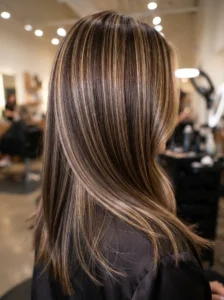
Let’s clear up the biggest misconception first, because the term “streaky highlights” can conjure some outdated mental images.
Modern streaky highlights involve placing fine, distinct strands of lighter color throughout the hair using a foil technique, rather than the hand-painted, graduated approach of balayage. The key difference from old-school chunky highlights is precision and scale. Today’s version uses much finer sections, more strategic placement, and often multiple complementary tones rather than one flat, contrasting color.
The result is a look with more visible dimension and movement than balayage typically offers, while still feeling sophisticated rather than dated. Where balayage creates a soft, sun-kissed gradient, streaky highlights create distinct, intentional lines of color that catch the light differently as your hair moves.
Why This Trend Is Replacing Balayage for So Many People
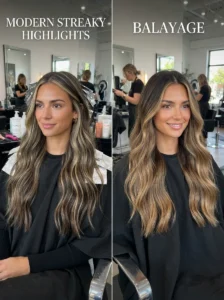
Balayage has dominated for years, and it’s not going anywhere entirely. But there are some clear reasons why streaky highlights are pulling attention away from it right now.
The regrowth is far less noticeable. This was the biggest selling point for me personally. Balayage is designed to grow out gracefully, but it still has a gradual transition zone that needs occasional maintenance. Streaky highlights, when placed correctly, can have an even less noticeable regrowth pattern because the foiled sections are finer and more evenly distributed rather than concentrated toward the ends.
It offers more dimension in person, not just in photos. Balayage often photographs beautifully but can look slightly flat or muted in everyday lighting compared to how it appears in professional photos. The more defined streaks catch ambient light in a way that creates visible movement and dimension even in ordinary, non-studio lighting.
It feels fresh after years of balayage saturation. Trends often shift simply because something has been so dominant for so long that people are ready for an alternative. After nearly a decade of balayage being the default highlighting technique, a lot of colorists and clients are simply ready for something that feels new.
It can be customized more precisely. Because streaky highlights use a foiling technique with finer sections, colorists have more precise control over exactly where lightness appears, which can be tailored more specifically to flatter individual face shapes and hair partings than the broader strokes of balayage.
How Streaky Highlights Differ From Old-School Chunky Highlights
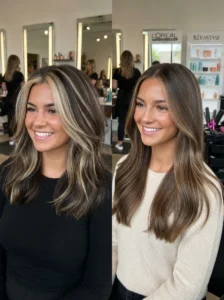
This is the distinction I needed clarified before I felt comfortable committing, so let me break it down clearly.
Section size: Old chunky highlights used very thick sections, often creating a visibly striped effect. Modern streaky highlights use much finer, narrower sections, creating subtle lines rather than bold stripes.
Color contrast: The 2000s version often used a single, high-contrast blonde against a darker base, creating a stark two-tone look. Today’s version typically uses multiple, closely related tones, creating a softer, multidimensional effect even though the individual streaks are more defined than balayage.
Placement strategy: Older highlighting techniques often applied a fairly uniform pattern across the whole head. Modern streaky highlights are placed strategically, often concentrated more heavily around the face and crown where light naturally hits, with a more relaxed, varied pattern throughout the rest of the hair.
Overall finish: The old version aimed for maximum visible contrast. The current version aims for dimension and movement while still reading as a cohesive, sophisticated color overall, not a collection of obviously separate streaks.
1. Face-Framing Streaky Highlights
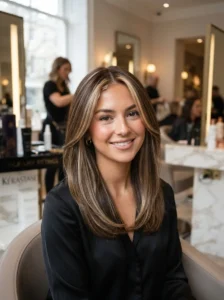
Fine, well-placed streaks concentrated specifically around the face, with the rest of the hair remaining closer to the natural base color. This version offers a brightening effect around the most visible part of the hair without committing to a full head of streaks.
This is actually the version I went with for my first appointment, since it felt like a manageable way to test the trend without a dramatic full commitment.
Best for: All hair lengths, those wanting a subtle introduction to the trend.
2. All-Over Fine Streaks
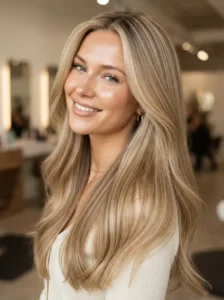
Consistent, fine streaking distributed evenly throughout the entire head, creating maximum dimension and movement. This version requires more time in the chair but creates the most dramatic, multidimensional result.
Best for: Medium to long hair, those wanting maximum visible movement.
3. Crown-Concentrated Streaks
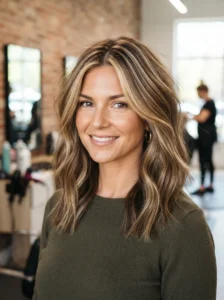
Streaking concentrated more heavily at the crown and top sections, where the hair catches the most natural light, with a more relaxed pattern toward the lengths and ends. This creates a brightening effect at the most visible angle without requiring full-head commitment.
Best for: All hair lengths, particularly flattering for those who often wear their hair down and parted.
4. Two-Tone Streaky Highlights
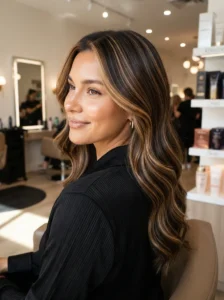
Rather than a single highlight shade, this version uses two complementary lighter tones woven throughout the streaks, creating even more dimension and a slightly more complex, multidimensional finish.
Best for: Those with some color experience wanting a more advanced, dimensional result.
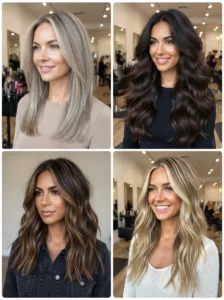
5. Streaky Highlights on Dark Hair
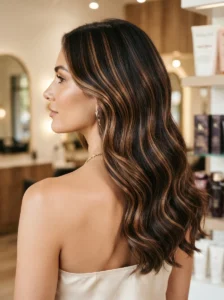
A version specifically tailored for deeper base colors, using slightly warmer or richer highlight tones to ensure the streaks complement rather than clash with a dark base. This combination tends to create dramatic, eye-catching contrast while still feeling sophisticated.
Best for: Dark brown to black base hair, warm to neutral skin tones.
6. Streaky Highlights on Blonde Hair
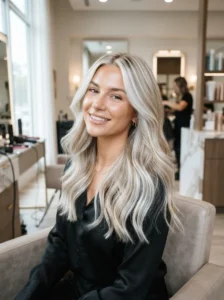
For those already blonde, this version adds even lighter, more precisely placed streaks to create additional dimension within an already light base, preventing blonde hair from looking flat or one-dimensional.
Best for: Light to medium blonde base hair.
7. Soft Pastel-Adjacent Streaks
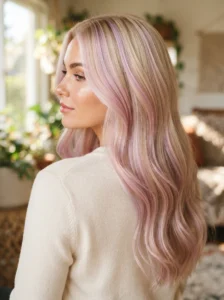
A more fashion-forward variation incorporating very subtle, barely-there pastel tones into the streaking pattern, creating an unexpected, delicate hint of color without committing to a full fantasy color treatment.
Best for: Those wanting a subtle creative color element.
How to Talk to Your Colorist About This Switch
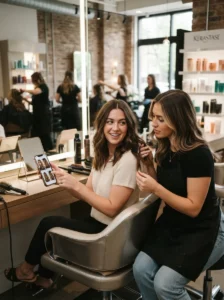
If you’re currently a balayage client considering this trend the way I was, here’s what helped make the conversation productive.
Ask specifically about foiling versus painting technique. Streaky highlights generally require foils for the precision the look depends on, which is a different process than the hand-painting technique used for balayage. Make sure your colorist is clear on which technique you’re asking about.
Discuss section size explicitly. Bring photos and point out whether you want very fine, subtle streaks or slightly more visible ones. The word “streaky” can mean different things to different colorists.
Talk about your current base color. Your colorist will need to assess how your existing balayage or base color will interact with the new foiling pattern, and may recommend a toning step to ensure everything blends cohesively.
Ask about the maintenance schedule realistically. While streaky highlights often have a more forgiving regrowth pattern than balayage, they still need periodic appointments. Get a clear sense of what that schedule will look like for your specific hair and chosen intensity.
My Honest Maintenance Experience So Far

A few months into this switch, here’s what I’ve genuinely noticed compared to my years of balayage maintenance.
The regrowth line is noticeably softer and less obvious than my balayage ever was at the same point post-appointment. I’ve actually been able to stretch my appointments slightly longer than I used to with balayage, which has been a pleasant and unexpected benefit.
My hair does require a bit more attention to toning between appointments, since the finer, more numerous streaks can show brassiness more readily than the broader strokes of balayage. I’ve added a toning treatment roughly every five to six weeks to keep everything looking fresh.
The overall shine and movement in my hair has genuinely impressed me. There’s a dimensional quality to how the light catches my hair now that my balayage, even at its freshest, never quite achieved in regular daily lighting.
Is This Trend Right for Everyone?
Despite how much I’ve enjoyed the switch, I want to be honest that this isn’t necessarily a universal upgrade for everyone currently doing balayage.
If you specifically love the soft, gradual, low-maintenance growing-out quality of balayage, the finer streaking technique may not deliver that same effortless regrowth experience, even though it can be less noticeable in its own way.
If you have very fine or thin hair, a very heavy, all-over streaking pattern can sometimes look slightly busier than it does on thicker hair, so discussing a more concentrated placement, like the face-framing or crown-focused versions, may be a better starting point.
If you’re someone who prefers minimal time in the colorist’s chair, be aware that a full head of fine, precise streaks can sometimes take longer to apply than a balayage application, depending on your colorist’s specific technique and your hair’s density.
Final Thoughts
I went into that appointment assuming I was getting my usual balayage touch-up and walked out with a completely different relationship to my hair color. The shift to streaky highlights wasn’t the dramatic, retro throwback I worried it might be. It turned out to be a more refined, dimensional evolution of what I already loved about highlighted hair.
If your colorist has mentioned this trend to you, or if you’ve been noticing it appearing more in your social feeds, I’d genuinely encourage giving it real consideration rather than dismissing it as a nostalgic throwback. The modern version bears very little resemblance to its 2000s predecessor, and the dimension it adds in everyday lighting is something balayage, for all its beauty, doesn’t always achieve in quite the same way.