I have what most stylists describe as a long, oblong face shape, and for years I avoided choppy bobs entirely because I assumed all that horizontal volume and textured width would make my face look even longer. It took an actual consultation, where my stylist patiently explained how choppy bobs can be specifically tailored to different face shapes rather than being a one-size-fits-all style, for me to finally understand how wrong my assumption had been.
I ended up getting a version specifically adjusted for my face shape, and it remains one of my favorite haircuts I’ve ever had. That experience sent me down a deeper research path into exactly how choppy bobs can and should be customized depending on face shape, which is exactly what I want to share here.
What Makes a Bob “Choppy” in the First Place
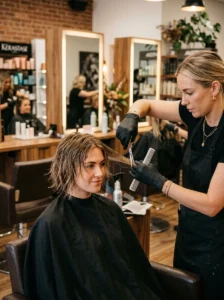
Before getting into face-shape-specific recommendations, it helps to understand what actually defines a choppy bob, since the term gets used fairly broadly.
A choppy bob features deliberately uneven, textured ends rather than a smooth, blunt line. This texture is usually achieved through point cutting, razor cutting, or a combination of both, creating a slightly jagged, piece-y finish rather than the clean, uniform edge of a classic bob. The choppiness can be concentrated mainly at the ends, or it can extend further up into the body of the cut through internal layering.
The beauty of this style is that the degree of choppiness, the length, and the internal layering can all be adjusted significantly, which is exactly what allows it to be customized for different face shapes rather than working identically on everyone.
Choppy Bobs for Round Faces
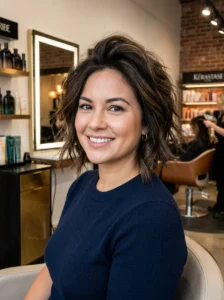
For round face shapes, the goal is typically adding angles and length to create the appearance of more definition, rather than adding width that could emphasize roundness.
The Angled Choppy Bob
A bob that’s noticeably longer in the front than the back, with choppy texturing throughout. The angled length creates a slimming, elongating effect along the jawline that works specifically well for round faces.
The Choppy Bob With Height at the Crown
Concentrating volume and choppy texture at the crown rather than at the sides draws the eye upward and adds vertical length to balance a rounder face shape.
My honest take: A friend of mine with a classically round face got the angled version last year, and the difference in how her jawline appeared was genuinely dramatic. The angle did exactly what her stylist promised.
Choppy Bobs for Oval Faces

Oval faces are often considered the most versatile for nearly any haircut, including choppy bobs, since the balanced proportions of this face shape work well with most styling choices.
The Classic Choppy Bob
A relatively symmetrical, chin-length choppy bob without significant angling or asymmetry. Oval faces can typically wear this most universal version of the style without needing specific adjustments.
The Choppy Bob With Curtain Bangs
Adding soft, choppy curtain bangs to an already textured bob enhances the face-framing effect while maintaining the balanced proportions that oval faces tend to suit naturally.
My honest take: I’ve watched several friends with oval face shapes try nearly every variation on this list, and almost all of them have looked great, which really does confirm how forgiving this face shape tends to be.
Choppy Bobs for Square Faces

For square face shapes, with a strong, angular jawline, the goal is typically softening that angularity rather than emphasizing it further.
The Soft Choppy Lob
A slightly longer, lob-length choppy cut with softer, more rounded texturing rather than sharp, blunt edges. The added length and softness help balance a strong jawline rather than drawing additional attention to it.
The Choppy Bob With Side-Swept Fringe
A side-swept fringe softens the forehead and draws the eye diagonally rather than emphasizing the horizontal lines of a square jaw, working in tandem with the choppy texture to create overall softness.
My honest take: This is actually my own face shape, and I specifically asked my stylist to avoid sharp, blunt angles at the jaw level when I got my version, opting instead for softer, more graduated texturing that complemented rather than competed with my jawline.
Choppy Bobs for Heart-Shaped Faces
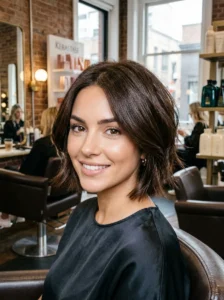
Heart-shaped faces, with a wider forehead tapering to a narrower chin, typically benefit from styles that add width or fullness near the jawline to balance the proportions.
The Choppy Bob With Stacked Volume
Extra volume and choppy layering concentrated toward the bottom of the cut, near the jaw and chin, helps balance a heart-shaped face by adding visual width exactly where it’s needed.
The Chin-Length Choppy Bob
Keeping the length specifically at the chin, rather than shorter or longer, places the fullest part of the choppy texture right at the point where heart-shaped faces benefit most from added width.
My honest take: A close friend with a heart-shaped face was initially nervous about bobs in general, worried they’d emphasize her narrower chin. The stacked volume version her stylist suggested did the opposite, adding exactly the balance she’d been missing.
Choppy Bobs for Long or Oblong Faces

This is my own face shape, and the category I researched most extensively before finally committing to my own choppy bob.
The Wide, Voluminous Choppy Bob
A choppy bob styled with significant width and horizontal volume throughout, rather than length-emphasizing height or vertical styling. This horizontal emphasis helps balance a longer face shape by adding visual width rather than additional length.
The Choppy Bob With Full, Blunt-ish Fringe
A fuller, more substantial fringe paired with choppy bob layering helps visually shorten a longer face by breaking up the vertical space of the forehead.
My honest take: This is exactly the version I eventually got, and my stylist was specific about avoiding any styling that added height at the crown, since that would have only emphasized the length of my face further. The wider, more horizontally-styled version made an immediate, noticeable difference.
Choppy Bobs for Diamond-Shaped Faces

Diamond face shapes, with narrower foreheads and chins and wider cheekbones, typically benefit from styles that add width near the forehead and chin to balance the prominent cheekbones.
The Choppy Bob With Wispy Bangs
Soft, wispy choppy bangs add width and softness specifically at the forehead, helping balance the narrower upper portion of a diamond face shape.
The Rounded Choppy Bob
A bob with softer, more rounded choppy texturing rather than sharp angles, which complements the angular cheekbones of a diamond face without competing with them.
My honest take: This face shape is less common, so finding specific guidance was harder during my own research, but the stylists I spoke with were consistent in recommending softer texturing and added width near the forehead specifically for this shape.
Universal Tips for Choppy Bobs, Regardless of Face Shape

Beyond the specific face-shape recommendations, a few principles apply across the board for getting a choppy bob that looks intentional rather than simply uneven.
Discuss the degree of choppiness explicitly. Some choppy bobs are very subtle, with just a hint of texture at the ends. Others are dramatic and heavily piece-y throughout. Be clear with your stylist about which end of that spectrum you’re picturing.
Bring photos showing the cut from multiple angles. Choppy texture can look quite different depending on the angle, so a single front-facing photo doesn’t give your stylist the full picture of what you’re hoping for.
Ask about styling requirements honestly. Some choppy bobs require daily texturizing product and active styling to maintain their shape, while others look intentionally choppy with minimal effort. Be honest about how much time you’re willing to invest.
Consider your hair’s natural texture. Naturally wavy or curly hair often enhances a choppy bob’s texture with minimal styling effort, while very straight, fine hair may need more product and technique to achieve the same piece-y definition.
How I Style My Choppy Bob

Since getting my own version, here’s the routine that’s worked best for maintaining the texture and shape day to day.
I apply a lightweight texturizing spray to damp hair before blow-drying, focusing on the ends where the choppy effect is most concentrated. While blow-drying, I use my fingers rather than a brush for the final styling pass, which helps maintain the separated, piece-y quality rather than smoothing it into a more uniform shape.
A small amount of texturizing paste worked through the ends once my hair is dry adds definition and helps the choppy pieces hold their separated shape throughout the day.
Final Thoughts
What I learned through my own research and consultation process is that “choppy bob” isn’t really one single haircut. It’s a flexible styling concept that can be adjusted significantly in terms of length, angle, volume placement, and texturing intensity to suit a wide range of face shapes effectively.
If you’ve avoided this style because you assumed it wouldn’t suit your specific face shape, the way I did for years, I’d genuinely encourage bringing this more detailed, face-shape-specific guidance to your next consultation. The right adjustments can make a significant difference, the same way they did for me.